Monday, 9 July 2012

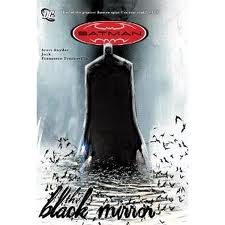
BATMAN: BLACK MIRROR by Scott Snyder, Jock & Francesco Francavilla

As well as being an epic feat of wildly imaginative storytelling, Grant Morrison's post-millennial run on Batman (and short-lived sister title Batman & Robin) accomplished two things that would shape the future of the caped crusader's adventures in print.  First, there was no longer any limitation on where story lines could be drawn from; any obscure, surreal subplot from the comic's dark and distant past was fair game once Morrison had established a continuity which took account of all the dark knight's past adventures, no matter how bizarre.  Second, Dick Grayson was established as a credible (and extremely likable) Batman.  Speaking as someone who had a strong dislike of the character during his time as Robin and Nightwing, I personally feel that Morrison (with a little help from Tony Daniel's surprisingly good Battle for the Cowl mini-arc) utterly succeeded in recreating Grayson as a sympathetic and compelling character, and the perfect fit for Bruce Wayne's successor as Batman.  What might have felt like sacrilege to many fans actually turned out to be a much-needed shot in the arm which rejuvenated the comic and opened the door to a whole new range of story-telling possibilities.

One such possible story is told by American Vampire scribe Scott Snyder in the Batman: The Black Mirror story arc. Eschewing the more supernatural elements in which his predecessor delighted, Snyder's tale is - at its heart - hard-boiled crime fiction, albeit with a deeply disturbing edge.  The story finds Dick Grayson, still new to his role as Batman, investigating several apparently unrelated crimes in Gotham city, each of which turns out to have some sort of link to his - or his mentor's - past.  The return of James Jnr, Commissioner Gordon's estranged and possibly disturbed son, to Gotham causes further complications for the dark knight, and as the myriad threads draw together the real evil at the heart of the story is revealed; an evil which may be part of the very fabric of Gotham itself.  Snyder's immaculate plotting ensures that the connections between multiple story lines never feel forced or jarring, and as the tale reaches its dramatic conclusion the reader becomes entangled in a web of madness and horror which mirrors the cracked mind of the book's ultimate villain.

The richness of the story would be compromised without characters that engage the reader, but fortunately this is an area in which Snyder also excels.  In his hands, Dick Grayson emerges as a rounded, flawed and believable hero who puts his own stamp on the Batman legacy.  He looks and moves like Batman, but he quips like Spider-Man, and his motives are not quite the same as his predecessor's; his lack of a pathological drive to fight crime becomes both a weakness and a strength over the course of the book.  His is a different kind of Batman, one who can allow some light to persist in a world of shadow, no matter how hard Gotham tries to drag him into its murky depths and snuff him out.  The Gordons, too, are fully realised emotional beings, rather than just the two-dimensional supporting characters that they might have been.  The Commissioner's weary perseverance in the face of overwhelming darkness has never been more quietly powerful, and Barbara's bravery in the face of danger and her unspoken, tenderly implied feelings for Dick are both deeply affecting.  James - the damaged, long lost son - is an enigma, and Snyder keeps us guessing at his true nature right up until the story's climactic confrontation.


As for the villains of the piece, Batman's traditional rogues' gallery is somewhat conspicuous by its absence, the one exception being the Joker, who plays only a small role in the story.  Snyder's Joker closely follows Morrison's masterful reinvention of the character, and again reminds us that he is the only one who truly understands the dark knight, recognising immediately that Grayson is not "his" Batman.  This aside, Snyder's villains consist primarily of gangsters, arms dealers and a group of wealthy Gotham socialites who attend a mysterious and sinister auction at "Mirror House".  But even these seemingly mundane foes are given an unearthly aura by the ever-present and corrupting influence of Gotham city - cast by Snyder almost as a villain in its own right.  The malign and shadowy presence of Gotham is present in almost every panel, creating an atmosphere so palpable you can almost taste it.  The city is the titular Black Mirror, throwing up warped reflections of all it encounters, bubbling far beneath Batman's penthouse as an uninviting and ever-shifting sea of madness and corruption.  Snyder's masterstroke in Black Mirror is to give Gotham a mind of its own.

Special mention must of course go to the artists, namely Jock and Francesco Francavilla, for visualising and maintaining the dense atmosphere of the book.  Jock's rugged lines convey beautifully the gritty environments and fluid action sequences that Snyder's story demands, and Francavilla's art, while more cartoonish, bathes the characters in a haunting, ethereal glow and weaves wonderful tapestries of flashbacks and inner thoughts.  Both prove themselves worthy successors to the likes of Frank Quitely and Frazer Irving in portraying the glamorous grime of Gotham and its inhabitants.

In short, Black Mirror is a fantastic Batman story.  By combining elements of crime, horror and emotional drama, Scott Snyder had created a gripping tale that can stand by itself as an excellent example of what Batman as a comic can achieve, as well as acting as a worthy addition to the ongoing saga of Dick Grayson's Batman.  Although Grant Morrison's shadow still hangs over the book, Snyder demonstrates that he's a strong writer with a unique voice and his own approach to characterisation, while still embracing key parts of the Morrison legacy.

Saturday, 17 March 2012

MIDNIGHT SNACKS by Not A Teepee

I know I've been remiss of late with these blog updates, but other commitments must unfortunately take precedence for the time being.  That said, I can't help but make an exception when the good folks over at the Not A Teepee collective produce another of their bi-monthly gems.  Midnight Snacks is the longest album they've put together for some time, clocking in at over 45 minutes, but as we've come to expect with these compilations there's not a minute of filler to be found among the 12 tracks gathered here.  It'll also come as no surprise to hear that this record features the same eclectic mix of styles and consistent high quality that has characterised all of Teepee's releases thus far, and it's good to see (and hear) that the collective is still going strong, 18 months after its debut release.

Highlights on this particular collection include How Deep Is The Valley's U Got 2 Feed My Love, which channels Prince and '80s King Crimson whilst mashing up grimey synths and choppy guitars; the slow-burning ethereality of tracks like No Rest At Midnight by It Is A New Day and Nervosa by Debutant; the unsetting clatter and gurgling of Matricarians' Boxing Day Leftovers; and the plaintive yet pointed acoustic offerings of Kitchen Cynics and John Hekert.  But cliched though it may sound, every track on this collection has something to offer, as its jagged musical journey unfolds from barely-whispered ballads to pulsing electronica.  Not A Teepee have. once again, proven themselves worthy of your attention.

As always, streaming and free downloads can be found at their bandcamp page here.

Wednesday, 4 January 2012

The Vinyl Problem

BBC 6Music is currently running a week of programs celebrating the vinyl record, a format which has recently regained a measure of popularity despite having long been technically obsolete.  Although more advanced, digital media have been available for decades, a recent surge in vinyl sales suggests that such records still have a unique appeal for music fans which can't be replicated by their only real physical rival, the CD.  The fact that a major radio station dedicated a sizable chunk of its festive airtime to a celebration of this format only serves to cement the idea of vinyl holding a special place in the hearts of fans and musicians alike, but what concerned me as I was listening to these shows was the extent to which the advocates of vinyl seem to be fetishising the form and - in doing so - sidelining the content of recorded music.  

When asked, people generally justify their favouring of vinyl over other formats in one of two ways; the sound of the record or the tactile satisfaction of having a physical artifact.  We will return to the former, but for now let's look at the latter.  The format of recorded music is not in and of itself relevent to the quality of that music, unless by its nature it degrades or enhances the intended sound quality of the recording.  I say "intended" because for some bands and artists low fidelity is an aesthetic choice.  The physical experience associated with a particular format of recorded music (and here the wallprint-sized artwork and ritualistic turntable operation of vinyl easily wins out over the simplistic and therefore less meaningful experience of CD usage) is an attribute which must be counted alongside the other, myriad paraphernalia of music-making and listening, none of which are essential to the music itself.  Just like the equipment a band uses or the recording techniques they utilise, the format of their recorded music is a part of the medium of delivery for their songs, but it is in no way essential to the music it holds.  And it is this music which is the band or artist's reason for existence; they would not (obviously) be musicians without it.  All else is secondary to the music written, played and recorded, and then preserved on plastic discs, digital files or whatever.  The format should always serve the music for which it acts as a conduit, which is why I find its apparent veneration somewhat troubling.

Vinyl is more romanticised than any other format of recorded music, fashion and nostalgia both playing a part in its resurgent popularity as well as concerns of sound quality and tactile experience.  This near-obsession with the medium of music draws attention away from the music itself, which is of course the reason for that medium's existence in the first place.  It's a hallmark of music geekery (I myself being a major culprit) to fetishise the assorted paraphernalia which surround the music we listen to, but we must accept that the format of recorded music is also to be counted among these non-essential elements of music-making and listening.  On occasion, it enhances the listening experience and enables musicians to get closer to a particular sound which they might have envisioned for their work, but generally it is incidental to the music itself, which is of course the most important part of the equation.  The music is the end, everything else is just the means.

Sunday, 18 December 2011

All Christmas songs are rubbish? CODSWALLOP!


IT'S THE ENRAPTURED CHRISTMAS BLOG!!!

Some people will tell you that there's no such thing as a good Christmas pop song, and that those tunes which do masquerade as such are all mawkish, cringe-inducing, nostalgia-fuelled tripe.  Now, many of the Christmas songs gifted to us by the latter part of the 20th century do indeed fall under this long-winded but nonetheless fair description, but there are a few - just a few, mind - which buck the trend.  You won't find any of them in such hallowed lists as are featured in respectable publications like this.  Lists like these feature only songs which have either received the near-universal seal of public approval (Fairytale of New York, War is Over) or revel in their own ridiculousness, whether they realise it or not (Mistletoe & Wine).  What I'm interested in are Christmas pop songs which stand on their own merits, but are often unfairly overlooked in favour of other, shinier hits.  They are still, however, songs which regularly appear on almost every compilation of Christmas pop tunes, so you've no excuse not to seek them out and rediscover their myriad charms this festive season.


1. A Spaceman Came Travelling by Chris de Burgh


'Tis a truth universally acknowledged that Chris de Burgh is rubbish; just ask Bill Bailey.  But like a stopped clock telling the right time once in a while he was destined to produce just one great tune, and this is it.  The lovely sound of proper '70s electric piano lets us know we're in for something special, and despite the insipid lyrics with their bizarre sci-fi take on the traditional Christmas story, de Burgh's voice on this track has what I can only describe as a haunting quality.  Plus, it has a chorus you can actually mosh to, if you try really hard.  Embrace it!


2. A Winter's Tale by David Essex


Singer and alleged actor David Essex's oeuvre is also somewhat lacking in quality tunes, with Rock On perhaps being one of only two exceptions (I don't care what you say!).  The other is this (sort of) Christmas song from 1982, with lyrics written by Tim Rice (best known for his later work with Disney on Aladdin, The Lion King et al).  Perhaps its mournful atmosphere prevents the track from being as widely celebrated as other '80s Christmas pop fayre, but it makes for a nice change in mood every time it turns up in the midst of gurning, parping Christmas party music.  Apart from marking one of the few occasions during the '80s when a soprano saxophone was utilised in a tasteful manner, I also find this song to be deeply evocative of cold winter days and colder winter nights.


3. The Power of Love by Frankie Goes To Hollywood


Lyrically, I'm not sure what this song actually has to do with Christmas.  Granted, the video has a nativity theme, but I think this may have been created to boost the track's chances of a high festive chart position back in 1984.  In any event, it has come by convention to be considered a Christmas song, and a very good one it is, too.  A lush, piano 'n' strings ballad will probably seem somewhat out of place for people who only know this band from hits like Relax and Two Tribes, but this song - in my opinion - trumps them both.  The chord changes and vocal melody are lovely, and singer Holly Johnson gets a chance to showcase his not unimpressive vocal talent.  Although there's a nicely ominous synth and drum break at about three minutes in with which they could have done so much more, Frankie Goes To Hollywood nonetheless showed that they were capable of wonderous things with this song.


4. I Believe in Father Christmas by Greg Lake


Using as its melodic basis the "troika" from Prokofiev's Lieutenant Kije Suite (which has itself come to be an incredibly popular piece of Christmas music, despite never having been intended as such by the composer), Greg Lake's festive tune is an underappreciated gem which actually features some rather anti-clerical lyrics; a fact not seemingly appreciated by most broadcasters.  With lines like, "they told me a fairy story till I believed in the Israelite", however, the intent seems unmistakable, despite what Lake and (lyricist) Peter Sinfield may have said subsequently.


5. In Dulci Jubilo by Mike Oldfield


Last but far from least is Mike Oldfield's reimagining of a traditional Christmas carol.  His take on In Dulci Jubilo has a nicely rustic feel overall, but the real treat comes about halfway through, when Mike busts out what I believe to be the ultimate Christmas guitar solo (TM).  Whether there are in fact any other Christmas guitar solos is quite irrelevant; this is the ultimate one.  Despite a couple of rather obvious fluffed notes.  Ahem.  Dig it!


These are, in my view, the five most underappreciated Christmas pop tunes ever.  All of them are worthy of your attention and re-appraisal, and I'll tell you why:  atmosphere.  It's something I bang on about an awful lot, but atmosphere is the truly essential component in creating a memorable piece of music.  These five tracks - irrespective of their various flaws and merits - all have atmosphere, specifically a Christmas atmopshere.  Maybe this is just rose-tinted nostalgia on my part - even though I wasn't alive when four of these tracks were originally released - but I recommend you give them a spin this Christmas.  They might even climb to the lofty rank of "guilty pleasures".

Sunday, 30 October 2011

MAURICE SENDAK by Not A Teepee

With a total running time of less than 15 minutes, this new release from the Not A Teepee collective is short and sweet, so there's really no excuse for you not to give it a listen, is there?  Ultimately, though, it's quality not quantity that counts, and fortunately this mini-album has the former in spades.

Maurice Sendak (named for the cantankerous author of Where The Wild Things Are) features 5 tracks from various Teepee regulars, and is infused with the same dreamy atmosphere so skilfully evoked by the work of its namesake.  These musical vignettes form a brief yet beautiful journey soundtracked by acoustic guitar, piano and heavenly organ which more than lives up to the high standards set by the collective itself on previous recordings.  Ranging from the exultant to the melancholic, the album's mood is ultimately one of longing, perhaps for the almost forgotten childhood world of imagination which Sendak himself so effectively captured.  As is now customary with Not A Teepee releases, the album's theme is borne out elegantly across the contributions gathered here.

As ever, streaming and free (legit) download is available here.

Friday, 30 September 2011

NORMAL SERVICE WILL RESUME....

The return to university is taking its toll on my free time, unfortunately.  As such, my Enraptured updates will be somewhat less frequent in the coming months, but this is not the end!  I'll still try to come out with dubious ramblings whenever I can, and normal service will be resumed once I am no longer slogging my guts out over piles of textbooks.  My thanks for your indulgence.

(I was going to add a humorous cartoon of a stressed-out student to this post, but the blogger platform is being....difficult.  That is all.)

Thursday, 15 September 2011

THE REAL MCCOY by McCoy Tyner

It can easily be argued that the advent of punk in the late 1970s shifted the emphasis from what musicians were playing to how they were playing it.  An obsession with the former proved the artistic downfall of the so-called progressive rock movement, but it's also an accusation that can also be levelled at many jazz musicians of the '60s.  Endless bars of passionless, clinical playing were the bane of a musical form which had only recently received a much-needed injection of innovation and verve from the likes of Ornette Coleman, Miles Davis and John Coltrane.  Despite the intervention of these revolutionary godfathers, however, jazz was sometimes in danger of losing itself in the technical what of music, rather than the passionate how.  Not so McCoy Tyner, Coltrane's former pianist and an accomplished player, composer and performer in his own right.

Tyner never lost sight of the how, as evidenced by the track Contemplation, from his 1967 album The Real McCoy.  The track's brooding atmosphere and seductive groove immediately drag the listener into a private, ethereal world of Tyner's own creation. but the magic really happens at approximately 4 minutes and 46 seconds in, when Tyner spends 8 bars hammering a single piano chord in his inimitable, percussive style.  The effect is stunning; in the midst of his solo, Tyner breaks off from his dexterous yet melodic tinkling to create an almost unbearable tension which keeps the listener spellbound - all with a single chord!  This is a pure expression of the power of how in music, a whole decade before punk's seismic impact. 

The rest of the album is also a testament to music with feeling, with the appropriately named Passion Dance unleashing a joyous cascade of notes powered by sheer emotion, and the tranquil Search For Peace showcasing all the very best elements of jazz balladry.  It's also wonderful to hear Tyner reunited with virtuoso drummer Elvin Jones, after their long tenure together in Coltrane's legendary quartet.  Tyner's massive chords and Jones' percussive tapestry combine - as usual - to forge a titanic sound which seems too overpowering to be the work of a single rhythm section, and fortunately this would not be their last record together.  Tyner has recorded (and continues to record) many great albums over the course of his long career, but The Real McCoy is arguably his best. and a good starting place for non-jazzers, to boot.  This is music to move you, music with passion in its DNA.  Music which is less about the what than the how.